


Skyscraper Technique SEO 2.0: Rank Without Writing More 2026
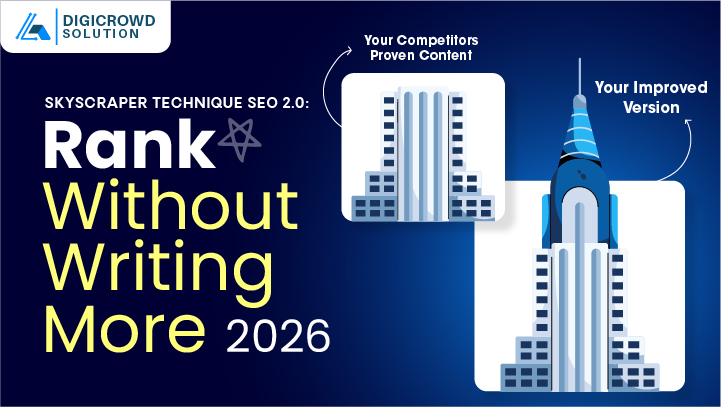
Everyone explains that to rank 1, you must have a 2,000-word paper and compose a 4,000-word paper. That belief is a direct copy of the original Skyscraper Technique, and it has been repeated so often that it has become a law of SEO for many people.
Nevertheless, such advice is outdated.
When you post 4,000 words of fluff, you lose users. Google pays attention when users fly away quickly, and your ranking drops, no matter how high you make your word counts appear.
The modern Skyscraper Technique does not consist of writing more. It's about writing better. In particular, it is concerning the alignment with search intent, better User Experience (UX), and better content quality.
It is Skyscraper Technique 2.0.
The Myth: "Just Make It Longer"
The SEO advice has had a formula over the years.
Find the top-ranking article.
Double the word count.
Add a few more headings.
Call it "ultimate."
That strategy worked in 2016. It barely works now.
Users today act differently. They skim instead of reading. They read rather than learn. They ditch pages that feel slow, overwhelming, or heavy.
Length is not quality. Helpfulness is a quality.
When your content takes five minutes to say what can be said in one, then you lose in terms of user experience. Readers feel trapped. And when they feel imprisoned, they leave.
Reality Check: Google Tracks People, Not Word Count
Google doesn’t reward effort. It rewards results.
Particularly, Google results in the interaction of real individuals with your page. It examines actions and not motives.
This Includes:
- How long users stay
- Whether they scroll
- Whether they click deeper
- Returning to search results or not
When users bounce, Google thinks that your content has not fulfilled the search intent.
Thus, you lose to impress an algorithm as well.
Your purpose is to solve problems faster than others.
Rankings are natural when you do so.
What is the Original Skyscraper Technique?
The first Skyscraper Technique was introduced by Brian Dean of Backlinko. It was an ever-changing move at that time.
It was a simple but powerful idea.
You discover content that is already ranking and already has backlinks. Then you create something bigger, like the skyscrapers, which are competing with each other.
The Old Rule
The traditional process resembled the following:
- Find popular content
- Make it more detailed and longer
- Contact websites that link to the original
It was very effective for many years.
But success made imitations.
Now everyone does this. The result? Google is filled with hyper-long articles that are tiresome to read and hard to navigate.
The issue is not the long-format content. The issue is the unnecessarily long content without a purpose.
Skyscraper 2.0: Pay Attention to Search Intention, Not Word Count
Herein, the modern skyscraper technique changes entirely.
Old SEO focused on keywords.
Skyscraper 2.0 concentrates on search intent.
"Search intent" indicates understanding what the user actually wants when they type a query.
For example:
When a person enters the query "how to tie a tie," what do they desire?
- An in-depth chronicle of the neckwear?
- Or a brief visual description that they can follow in less than a minute?
Clearly, they desire speed and clarity.
Any amount of additional words can rescue your article if it ignores the intent.
Action: To implement this today
Open the first page of your ranking page.
Do not ask:
"How can I make this longer?"
Instead, ask:
“What has not been explained clearly on this page?”
Look for:
- Missing examples
- Vague explanations
- No visuals
- Poor structure
- Confusing flow
That gap is your opportunity. Filling this gap is the new skyscraper technique.
Enhance User Experience (UX) to Retain Readers on the Page
Even with great ideas, you may not achieve your goals because of a bad user experience.
UX is no longer about the aesthetics. It's about comfort.
Your page must not scare the users, and even if your information is correct, they will not read it.
The "Wall of Text" Problem
Text walls are murderers of interest.
They create friction.
They slow reading.
They overwhelm the eye.
Bad UX usually includes:
- Long paragraphs
- Dense formatting
- No breathing room
- No visual breaks
A bad presentation cannot be overpowered by strong content quality.
The Solution: Organize It All
Skyscraper Technique 2.0 considers structure as a ranking criterion.
Specifically:
- Add a table of contents
- Keep paragraphs under 3 lines
- Make extensive use of bullet points
- Bold key ideas
- Insert visuals every ~300 words
When your content is easy to use, it is a result of good UX. Easy content gets read. Read content ranks.
Depth vs. Width: Not Behind the Curtain
This concept will forever change your approach to writing: ‘depth vs. width.’
“Width” implies inserting random subjects to get a bigger word count. This is bad. It's fluff.
Example of width (BAD):
- You are writing about the “best email marketing tools”
- You put a part in the “history of email” (irrelevant)
- You insert another paragraph about “how SMTP works” (too technical)
- You include a digression on the subject of “email etiquette in the workplace”
Word count is increased; however, it does not matter.
That is what the majority of people do wrong when utilizing the original Skyscraper Technique. They believe that the more subjects, the better the content.
Nevertheless, an increase in the number of topics is usually associated with diluted content.
"Depth" refers to breaking down a complex idea in a more understandable way using examples. This is good. This is content quality.
Example of depth (GOOD):
- Your article is regarding the “best email marketing tools”
- You do not simply provide the list of tools, but you demonstrate how to use them
- You provide screenshots of the dashboard with annotations
- You describe your pricing in simple English (not marketing lingo)
- Features are compared side-by-side in a table
- You also provide actual results: “We used Tool X for 6 months, and open rates grew by 43%.”
- You give the advantages and disadvantages of each tool
- You respond to certain questions, such as “Can I import my contacts from Gmail?”
See the difference? Width adds random topics. Profiling contributes useful information to the same topic.
So, it is not enough to add more words. Add more value.
Imagine it the following way: would you prefer a buffet consisting of 50 average dishes or 5 amazing dishes with a fine dining experience? Your readers are the same as the content.
The "Pattern Interrupt" Hook
Everything depends on the first five seconds.
Nothing else matters if your introduction is dull.
Whether to remain or not depends on the readers. Such a choice affects the level of engagement, scroll depth, and ranking potential.
What Not to Do
Avoid intros like:
- Dictionary definitions
- Long personal backstories
- Generic SEO explanations
They don't create urgency.
What Works Instead
Use a pattern interrupt.
That can be:
- A bold claim
- A controversial statement
- A surprising statistic
- A direct challenge
For example:
“Most of the bloggers spend half of their writing time in search of word count.”
That stops scrolling. That earns attention.
And attention is the doorway to rankings.
Why Long-Form Content Works (When It's Earned)
Let's be clear.
Long-form content is not bad. In many cases, it's necessary.
Complicated issues need room. Guides are sophisticated and require detail. Careful coverage is expected by some search intent.
But length should not be unreasonable.
Long content works when:
- It is a truly complicated subject matter.
- The user expects depth.
- Each section adds value.
- Nothing feels padded
The Skyscraper Technique 2.0 does not disrespect that balance.
It asks: “How long does this need to be to fully solve the problem?”
Not: ”How long is the article of my competitor?”
That alone is the difference between an amateur and a professional.
Common Mistakes to Avoid in the Skyscraper Technique
People still commit errors even when using the Skyscraper Technique 2.0. Hence, watch out for the following pitfalls:
Mistake 1: Keyword stuffing
You do not need to repeat your keyword 50 times. Google is smarter than that. But do not feel compelled to use your keyword in the following:
- The first paragraph
- 2-3 subheadings
- All over the body (where it would be sensible)
Mistake 2: Overlooking Mobile Users
More than 60% of searches are conducted on mobile. Unlike desktops, the users of mobiles require the following:
- Short paragraphs with 1-3 lines
- Larger fonts
- Fast-loading images
Mistake 3: Writing to yourself and not the reader
It is important to keep in mind that content quality resolves the problem of the reader. In particular, do not flaunt your expertise. Teach clearly.
Future of SEO copywriting: Accuracy, not quantity
SEO copywriting nowadays is about alignment.
Alignment between:
- Search Intent
- Content structure
- Readability
- Speed of answers
Google has been judging content quality more and more on usefulness, not verbosity.
Users are more likely to stay, scroll, and interact, which means that you will win.
If they bounce, you lose.
Consequently, write accurately. Remove fluff. Respect the reader's time.
In this way, the skyscraper technique survives in 2026.
Strategies to hook readers
Begin with a statistic: 93% of all online experiences start with a search engine. (Creates authority)
Make a controversial statement: "The majority of SEO tips are garbage." (Creates intrigue)
Share a personal experience: "I have spent five thousand dollars on an SEO company. They got me zero traffic." (Creates relatability)
Ask a question: “What do you think of it if I told you that longer content does not necessarily mean high rankings?” (Creates curiosity)
Offer a striking statistic: "On average, the best article receives 1.2% of all clicks on that keyword." (Creates surprise)
Make a comparison: “SEO writing is writing what is like fishing. You must have the correct bait for the correct fish.” (Creates visualization)
Thus, the opening of your introduction needs to be attention-getting. This falls under user experience.
In addition, your hook must be value-promising. Instruct readers on what they are going to learn. Examples: “You will learn to rank higher than an article of 5,000 words using only 1,500 words in this guide because you won't be writing about the number of words you write but the intention of the users.”
Summary: Better Than a Thousand Words is quality
It is possible to beat a 5,000-word piece of text with a guide of 1,500 words.
IF your guide:
- Matches Search Intent Exceptionally
- Provides a high-quality User Experience (UX)
- Improves Content Quality
- Solves the problem faster
The new skyscraper technique is not associated with height.
It's about precision.
So stop counting words.
Start counting the value.
Now go critique an article of your competitor.
Don't look at how long it is.
Search for the things they have neglected, and build a building there
Related Blogs


Link Building Without Outreach: Earn Backlinks Without Cold Emails
Published: 04-Feb-2026
Stop cold emailing. Master white hat link building without outreach. We cover passive tactics, HARO link building, and essential link building tools for growth.
Read More
Organic Traffic Drop? 60-Minute Technical SEO Audit (2026)
Published: 10-Feb-2026
A systematic Technical SEO Audit is needed to determine precisely what went wrong. Let us conduct a methodical diagnosis of your site within the next 60 minutes
Read More
Zero-Click Search: 5 Secrets to Reclaim Traffic
Published: 29-Jan-2026
Is Zero-Click Search stealing your traffic? Dont let Google win. Discover 5 expert tactics to adapt, win snippets & reclaim visibility. Future-proof your SEO!
Read More
Comments
0 Comments
Submit Your Comment Here

