


Why Lucknow Businesses are Shifting Budgets from Traditional to Digital in 2026
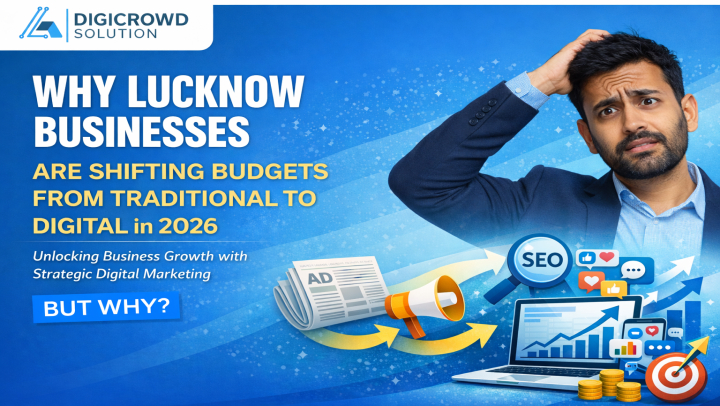
Lucknow's business environment is being swept by the winds of change. As the local business landscape evolves heading into 2026, the trends in digital marketing are transforming how local companies reach their clients. Whether you are a conventional mithai shop in Hazratganj or a technology beginner in Gomti Nagar, it is not only useful to know the digital marketing trends in Lucknow in 2026 but also crucial. The replacement of billboards with bytes and pamphlets with pixels is the greatest change in the communication methods used by businesses with their audiences. Digital marketing in Lucknow 2026 is turning out to be the main avenue upon which businesses are growing, competing, and prospering.
This change is not taking place in a vacuum. The businesses in Lucknow are experiencing a change in consumer behavior, technological availability, and market dynamics like never before. Traditional marketing is becoming less and less effective as digital channels are giving measurable and scalable returns.
Awakening of Digital Marketing Trends
Lucknow has always been a highly cultural and historical city, and the year 2026 is the time when the tradition is going to collide with innovation. Local businesses are finding that their customers, be it the purchasers of the chikankari or those seeking IT services, are on the web. The increasing internet penetration in the city, along with the low cost of smartphones and competitive data plans, has formed a digitally aware consumer population that demands real-time information, smooth experiences, and customized relations.
Companies that used to be dependent on the flow of traffic and word-of-mouth advertising became overnight invisible to online-searching consumers. This wake-up call led to several Lucknow businesspersons rethinking their entire marketing measures. In this day and age, collaborating with a digital marketing company in Lucknow is a survival tactic.
The Digital Budget Shift
The shift in marketing budgets towards the digital sphere as opposed to the traditional one indicates several important issues.
First, classic advertisements through print advertisements, radio and TV commercials, and outdoor billboards have a low degree of targeting and practically no real-time performance metrics. Online marketing offers a higher level of granularity of targeting, which allows businesses to target certain demographics, geographic areas, interests, and behaviors.
Second, cost-effectiveness is a determining factor. A full-page advertisement in a newspaper can cost tens of thousands of rupees, and still, there is no assurance that it will reach the interested buyer. The same budget could be used to produce qualified leads through focused social media campaigns or search engine marketing, and detailed analytics will provide the exact performance of every rupee.
Third, the behavior of the consumers has shifted. Individuals do not have to wait until Sunday newspapers so as to organize shopping. They do it all through their phones, scrolling Google, Instagram, and reviews, comparing prices, and making buying choices. The companies that are not found in these online touchpoints do not exist at all to the new generations of consumers.
The Performance Marketing Emergence
Accountability is one of the reasons why businesses are adopting digital channels. Old-fashioned marketing is an act of belief and projected impressions. Digital marketing works on data and quantifiable results. All the clicks, views, interactions, and conversions are traceable, analyzed, and can be optimized.
A digital marketing agency in Lucknow adopts performance marketing, whereby the businesses pay for results and not exposure. This radical change is that marketing budgets are investments whose returns are measurable and not costs whose outcomes are not certain. In the context of small and medium enterprises that lack sufficient budgets, this is a democratization of marketing, in the sense that these enterprises can compete well with the larger ones using savvy and data-driven campaigns.
Local Strength Meets International Access
Internet marketing has given the businesses in Lucknow an upper hand like never before, the opportunity to remain in close contact with the local market, and at the same time reach regional, national, or even international markets. A boutique based on chikankari can serve customers in Hazratganj and ship goods to Mumbai, Delhi, or regions abroad. A consulting firm can serve the local customers and set the thought leadership by the use of content marketing that brings opportunities throughout India.
The optimization of the search engines makes sure that the customers in the localities find the businesses when they are in need of the relevant products or services. Community and brand loyalty are created through social media marketing. Email marketing fosters a relationship with customers. Expertise and trust are created through content marketing. All the digital channels have been fulfilled to fill distinct roles as they collaborate to form all-inclusive marketing ecosystems that were not possible through the traditional approach.
The Advantage of Technology Infrastructure
The existence of improved internet connectivity, increased smartphone usage, and more digital literacy of consumers provides an excellent environment in which digital marketing activities may attain success. Moreover, there has been the development of many local agencies and service providers who provide niche-based digital marketing services, which are sensitive to market dynamics and cultural peculiarities in a particular region.
This domestic knowledge is critical. A reliable company knows the culture of the city, the tastes of the consumers, seasonal variations, and the competition in the city, which generic marketing strategies cannot compete with. They understand when to advertise in festivals, how to communicate in a manner that will appeal to the local people, and which channels will help to achieve the greatest returns with certain types of businesses.
Integration Instead of Replacement
Notably, the digital transformation does not imply the exclusion of traditional marketing. Good companies are combining online and offline strategies. A hoarding could contain a QR code that will lead to a landing page. A television advertisement may compel customers to social media platforms. The print ads may contain hashtags or web links.
It combines the advantages of both worlds, which are traditional marketing's wide awareness potential and digital marketing's precise targeting/measurement abilities. Nevertheless, the budgetary allocation is being directed more to online platforms where interaction is more extensive, the expenses are reduced, and outcomes are more apparent.
Business Growth Future-Proofing
The most convincing rationale for this budgetary change is perhaps future-readiness. Digital marketing potentialities are not only fulfilling the current requirements but also equipping businesses with future possibilities. Voice search and augmented reality, along with other technological innovations that are changing the consumer experience, transform businesses with high levels of digital underpinnings more readily than those that continue to rely on traditional means of communication.
The companies that are embarking on this shift in the present are setting themselves up as leaders in the market in the future. They are creating online assets: websites, social media followings, email newsletters, and content archives, which accrue value as time goes on. They are building organizational potential and people's mindsets of being innovative and not changeable.
In Conclusion: The Digital Imperative
The traditional-to-digital marketing in Lucknow is not a craze; it is a paradigm shift in the way businesses and customers interact. The companies that will find their way forward into 2026 will find a chance to grow, as the companies that live using the traditional method will not be able to do so. The fast and slow categories only fail to realize that they might be more and more marginalized in a world where digital presence means having a business.
It is not whether you need to change your budgets to digital marketing, but it is how fast you can change your budgets into digital marketing. The possibilities are unlimited with the appropriate digital marketing agency in Lucknow behind your plan.
Frequently Asked Questions
- Why Are Lucknow Businesses Shifting Budgets from Traditional to Digital in 2026?
Lucknow businesses are reallocating their budgets toward digital channels because better targeting, quantifiable outcomes, and cost-effectiveness, and can reach the customers at the same time, when they do not spend most of their time in other places online. The old marketing system is not as precise and accountable as the current business needs to ensure that it competes in the more digitalized world.
- How to split a digital marketing budget?
A typical balanced digital marketing budget consists of paid advertising (PPC, social media ads) at 40% of the budget, content creation and SEO at 30% of the budget, tools and technology at 20% of the budget, and experimentation with emerging platforms at 10% of the budget. Nonetheless, the best splits differ according to business interests, industry, competition, and level of growth. Established companies may spend more on retention, whereas startups focus more on acquisition channels.
- What are the 7 types of digital marketing?
The seven main categories of digitally marketed products include search engine optimization (SEO), pay-per-click advertising (PPC), social media marketing, content marketing, email marketing, mobile marketing, and marketing analytics. Each is used for special purposes in overarching digital strategies, collaborating to draw in, engage, transform, and keep customers in all kinds of digital touchpoints.
- What are the 4 pillars of digital?
Digital marketing has four pillars: content (worthwhile information that appeals to audiences and engages them), channels (where you meet the customers), data (information that helps to make decisions), and technology (tools that can help to carry out and measure them). Each of these pillars is interdependent—effective digital marketing is created by strong content that is distributed using the right channels, measured using data, and driven by technology.
- What is the 70/20/10 rule in digital marketing?
The 70-20-10 rule gives the idea that you should spend 70 percent of your budget on strategies that have proven to be effective and have shown consistent results, 20 percent on new strategies that have potential but require confirmation, and 10 percent on the potential breakthrough opportunities that the experimental strategies may unlock. Such a moderate line of action can deal with risk but help to encourage innovation and avoid either extreme conservatism or dangerous experimentation.
- What is the 7 times 7 rule in marketing?
The 7 times 7 rule states that a potential customer must see your marketing message seven times within seven days before acting. This principle highlights the need to give repeated exposure in a number of touchpoints. It elaborates on the reasons as to why an integrated campaign involving multiple channels normally succeeds over single channels because this enhances frequency and reinforcement of messages.
- What is the 3 3 3 rule in marketing?
The 3-3-3 rule of content marketing implies that you should produce three types of content (educational, entertaining, and promotional), deliver them on three channels (where your audience is), and deliver three pieces a week. This system proves diversity in the content, proper platform coverage, and its constant presence without confusing people and overcommitting the resources.
- What is the 1% rule in marketing?
The 1 percent rule, otherwise known as the 90-9-1 rule, notes that in the online community, 90% of the users are mere consumers, 9% sometimes contribute, and 1 percent make most of the content. This understanding of this distribution assists the business in making realistic expectations about the content created by users, their engagement levels, as well as their participation in the community, and the strategies to turn passive viewers into active followers.
Ready to future-proof your Lucknow business? Contact DigiCrowd Solution today for a free consultation and let’s build your 2026 digital roadmap
Related Blogs
7 Reasons to Choose Digital Marketing Company in Lucknow
Published: 26-Jun-2025
Digital marketing, also known as online marketing, is perhaps the process of promoting a brand to make contact with potential customers via the internet as well as other kinds of digital communication.
Read More
B2B Digital Marketing Strategies: Why Digital Marketing Agency is Important for B2B Business?
Published: 16-Jul-2025
A skilled B2B digital marketing agency also plays an important role in the success of a certain business.
Read More
Grow your business with best online advertising agency in Lucknow
Published: 05-Jul-2025
Every company or business has an online advertising agency now to take care of its online business expansion in the online world that is constantly changing.
Read More
7 Powerful Benefits of Digital Marketing for Small Businesses
Published: 18-Jul-2025
Digital marketing can be defined as marketing products and services through online channels such as websites, mobile applications, and social media
Read More
Comments
0 Comments
Submit Your Comment Here

